
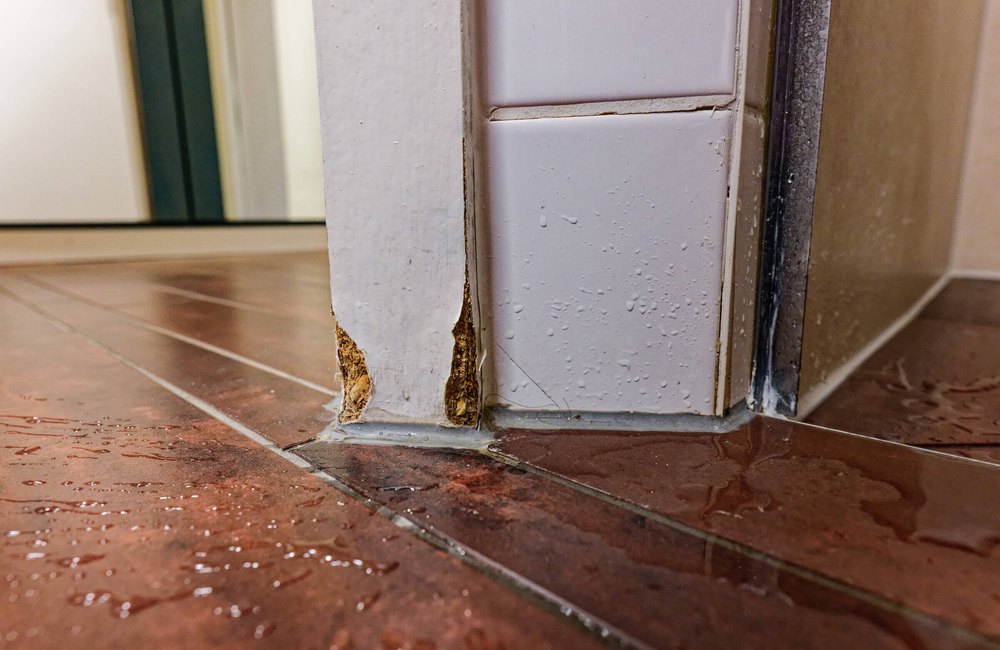
Water finds the weakest detail in an assembly and exploits it. That is why water intrusion is one of the most productive areas in defect work: the failure is rarely random, and the path almost always leads back to a specific detail that was executed differently from the way it was required to be.
Establish the entry point first
The staining an owner reports is usually not where the water is entering. Water travels along framing, behind finishes and across horizontal surfaces before it appears, and chasing the visible damage instead of the source produces a repair that does not hold.
The sequence is to identify the entry point, then establish whether the detail at that point was built as required. Moisture readings, opened assemblies where access allows, and inspection of the envelope conditions above and around the damage all contribute. Until the entry point is fixed with evidence, any opinion about cause is provisional.
The details that fail
Envelope failures concentrate in a small number of places, and water intrusion review focuses there:
- Flashing. Missing, short, reverse-lapped or terminated without an end dam. Flashing errors are the most common single source.
- Weather barrier and sealant joints. Laps run the wrong way, joints left unsealed, or sealant applied to a surface it will not bond to.
- Window and door penetrations. Where the opening detail was not executed in the sequence the manufacturer requires.
- Roof terminations and transitions. Changes in plane and material, and the drainage conditions around them.
Each of these is an installation question rather than a design question, which is what makes them workmanship findings.
Condensation is not the same as a leak
Not all interior moisture came from outside. Condensation within an assembly can produce staining, swelling and finish damage that presents exactly like a leak, and it has different causes: vapour movement, insulation continuity, ventilation and the interior conditions the building runs at.
Separating the two matters, because they lead to different responsible parties and different corrective scopes. A report that assumes intrusion without excluding condensation has skipped a step that opposing counsel will find.
Where mold fits
Mold usually arrives as a consequence rather than as the claim itself. It indicates that moisture was present long enough for growth, which makes it useful evidence about duration and about whether a condition was ongoing rather than recent.
The supporting role is identifying the moisture source and the construction condition that allowed it. Laboratory analysis and air-sample interpretation fall outside that credential and are referred out. Keeping that line clear is deliberate.
Wear, maintenance, or defect
Sealant has a service life. Drainage paths block when they are not cleared. A building that has gone years without maintenance will show moisture conditions that are nobody's construction fault.
The question is whether the condition is consistent with the age and maintenance history of the building, or whether it reflects a detail that was never going to perform because of how it was built. A joint that failed after a normal service life is maintenance. A flashing that was reverse-lapped at installation was going to leak from the first significant rain, and the timing of the first reported intrusion often tells you which one you are looking at.
Documenting it while it exists
Water damage gets repaired quickly, and repairs destroy the evidence of cause. Photographs taken before remediation, moisture readings taken while the condition is active, and any record of when intrusion was first observed are worth more than anything that can be reconstructed later. Where the condition has already been remediated, the analysis works from what survives in the record, and the limits of that are stated plainly rather than papered over. The same approach carries through workmanship findings generally.
Discuss a matter
If you are evaluating a construction defect claim in Chicago or Cook County, send the parties, the property and the key dates for a conflict check and a scope discussion. Paul Gaston can be reached at paul@expertwitness.co or on 773-619-1226, or through the contact page.